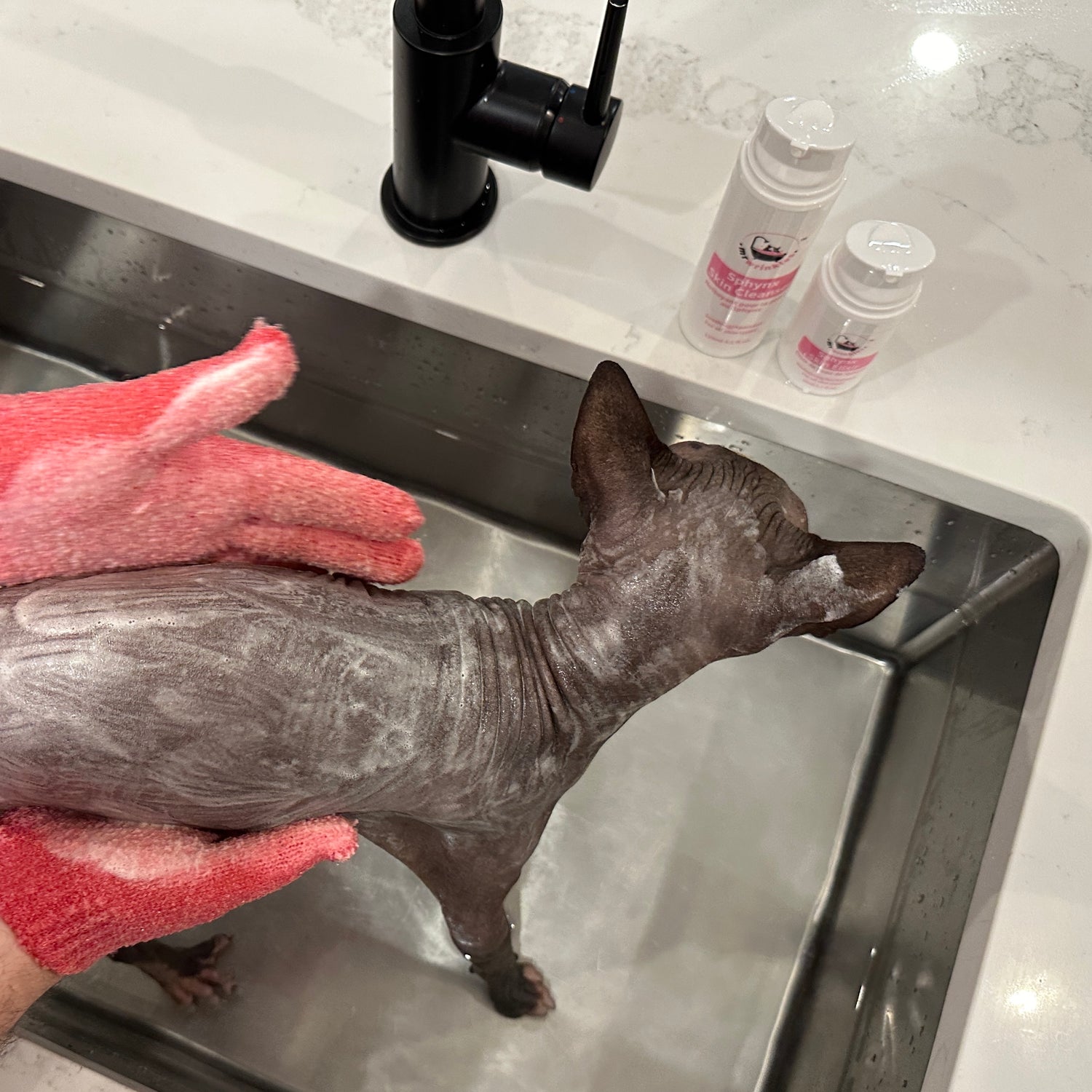


Why Most Cat Shampoos Don’t Work for Hairless Cats (And What to Use Instead)
Share
When people bring home their first Sphynx or other hairless cat, one of the first questions they ask is simple: what shampoo should I use?
Naturally, many owners start with a product labeled “cat shampoo.” It seems like the safest choice. But after a few baths, something often feels off. The skin may feel dry, greasy again within a few days, or oddly tight after bathing.
The reason is surprisingly simple: most cat shampoos were designed for fur, not exposed skin.
As fellow Sphynx owners ourselves, we ran into this confusion early on. Many products on the market were clearly formulated with coated cats in mind, and the results on hairless skin were often inconsistent. That experience eventually pushed us to take a deeper look at how skincare for hairless cats actually works.
We explore the full routine in our Ultimate Guide to Hairless Cat Skincare, but one of the most common questions owners ask is about shampoo.
The Short Answer
Most cat shampoos are designed to clean fur and coat, not exposed skin. Hairless cats like the Sphynx produce natural oils that sit directly on the skin’s surface, so formulas built for coated breeds can remove too much oil or disrupt the skin barrier.
For hairless cats, look for cleansers that are formulated specifically for feline skin, maintain a balanced pH, and use gentle ingredients designed for skin care rather than coat conditioning.
Hairless Cats Are a Skin-First Species
Cats with coats rely on fur as a buffer between their skin and the environment. That fur absorbs oils, traps dirt, and distributes natural sebum along the hair shaft.
Hairless breeds like the Sphynx, Donskoy, and Peterbald don’t have that protective layer. Their sebaceous glands still produce oil, but instead of traveling through fur, it sits directly on the skin’s surface.
This creates a different set of needs:
• oils accumulate directly on the skin
• pores are more exposed
• the skin barrier can become imbalanced more easily
• environmental dust sticks more readily
Because of this, hairless cats benefit from skincare designed for the skin itself, not coat conditioning.
With our own senior Sphynx, Mr. Wrinkles, and his two younger brothers we went through this same learning curve. Early on we tried several traditional pet shampoos and quickly discovered that some left his skin feeling overly dry while others seemed to trigger faster oil buildup. Those experiences were part of what pushed us to study hairless cat skincare more closely.
How Most Cat Shampoos Are Designed
Traditional cat shampoos are formulated with coated breeds in mind.
Their chemistry is optimized for:
• lifting dirt from hair shafts
• removing dander from fur
• rinsing easily through thick coats
• leaving fur soft and shiny
Those goals make perfect sense for long-haired or double-coated cats. But when the same formulas are applied directly to bare skin, the experience can be very different.
Without fur acting as a buffer, stronger shampoo products may remove too much natural oil from the skin. The result can be a cycle many hairless cat owners recognize:
- Skin feels very clean after a bath
- Oil returns quickly
- Owners bathe more often to compensate
This over-stripping cycle is one reason many people feel like they are constantly bathing their Sphynx.
Common Shampoo Mistakes Hairless Cat Owners Make
Before diving into common mistakes, it’s worth acknowledging something experienced Sphynx owners already know: every cat’s skin is a little different. Some owners develop routines that work well for their individual cat, even with products that might not seem ideal on paper.
The goal here isn’t to criticize those approaches, but to offer alternatives for owners who are struggling with skin balance or simply want a routine designed specifically for hairless cat skin.
Because reliable information about hairless cat skincare is still relatively limited, many owners experiment with products that seem gentle or familiar. A few examples come up again and again in owner forums and breeder groups.
Baby Shampoo
Many people assume baby shampoo must be safe because it is gentle for human skin.
However, human products are usually formulated around human skin pH, which differs from feline skin. Repeated use can gradually disrupt the skin’s natural balance.
Dish Soap
At some point nearly every Sphynx owner hears the suggestion to use dish detergent.
Dish soaps are designed to break down grease and cooking oils. They are extremely effective at that job, which is why wildlife rescue organizations sometimes use them in extreme situations such as oil spills.
Unless your cat has been caught in an oil spill, though, dish detergent is far stronger than delicate feline skin requires.
Medicated Shampoos
Veterinary shampoos can be extremely helpful when a cat is dealing with bacterial or fungal skin issues. These products are designed to treat specific conditions and are often recommended by veterinarians for short-term use.
Problems arise when they become part of a regular bathing routine. Antibacterial ingredients can remove both harmful and beneficial microorganisms, making it harder for the skin to maintain its natural balance.
Why “Dog & Cat” Shampoos Usually Miss the Mark
Another category that appears frequently in pet stores is the multi-species “dog & cat” shampoo.
While convenient for households with several pets, these products are rarely optimized for the biology of either species.
Dogs and cats differ in several important ways:
• skin pH varies between species
• cats groom themselves constantly and may ingest residues
• ingredients considered safe for dogs may irritate cats
Because of these differences, formulas designed for multiple species often end up being a compromise rather than a precise fit.
For hairless cats in particular — whose skin is fully exposed — species-specific formulations are usually the safer choice.
Marketplace Shampoos Without Transparency
Today many pet care products are sold through large online marketplaces such as Amazon and others. These platforms can be a convenient way to discover both established brands and smaller specialty products.
However, owners may also encounter shampoos marketed specifically for hairless cats that appear under unfamiliar brand names and provide very little information about what’s actually inside the bottle.
In recent years, many of these products have originated from overseas manufacturing marketplaces, where the same formula may be sold under multiple brand names with identical packaging. These products often appear at unusually low prices and may claim to be formulated in North America or Europe despite limited information about where they are actually made.
Common warning signs include:
• missing or incomplete ingredient lists
• vague product descriptions
• unclear country of origin
• no information about manufacturing standards or testing
Because hairless cats rely directly on the health of their skin barrier, transparency becomes especially important. When a product will be used regularly on exposed skin, it’s worth choosing brands that clearly disclose their ingredients, manufacturing practices, and country of origin.
For many owners, simply choosing products made by transparent brands operating under established cosmetic manufacturing standards can help avoid unnecessary risk.
Transparency Matters: Ingredients and Manufacturing Standards
Unlike human cosmetics, pet skincare products are not always required to disclose full ingredient lists.
That means two shampoos with similar marketing claims may contain very different formulas.
For owners trying to evaluate quality, transparency becomes an important signal.
Look for products that provide:
Full ingredient lists
Ideally listed using INCI (International Nomenclature of Cosmetic Ingredients) naming conventions. While not mandatory for pet products, brands that publish INCI lists are typically operating with higher cosmetic-grade standards.
Clear country of origin
Knowing where a product is manufactured helps ensure it is produced under recognized safety regulations.
Professional manufacturing environments
Products produced in facilities that follow human cosmetic manufacturing practices generally have stronger quality control and stability testing.
When products are applied regularly to exposed skin, transparency about what is inside and how it is made becomes part of responsible care.
Bathing Isn’t the Only Tool
Another misconception is that hairless cats need a full bath every time their skin feels oily.
Many experienced Sphynx owners eventually find success with a mix of approaches:
• occasional full baths
• gentle wipe-downs between baths
• clean bedding and clothing
• supporting the skin barrier with nourishing ingredients
A Skin-First Approach
Over time many hairless cat owners arrive at the same realization: caring for a Sphynx isn’t really about shampoo at all.
It’s about skincare.
Instead of treating bathing as a deep-cleaning event, the goal becomes maintaining the skin’s natural balance with gentle cleansing and supportive ingredients.For a deeper look at how bathing, cleansing, and skin balance work together, see our Ultimate Guide to Hairless Cat Skincare.
Building a Simple Routine
Every cat’s skin is slightly different, but a balanced routine often includes:
• a gentle bath every week or two
• light wipe-downs between baths
• avoiding harsh detergents or aggressive cleansers
For a deeper look at bathing routines and daily care, see our Ultimate Guide to Hairless Cat Skincare, which walks through a complete routine step by step.
Key Takeaways
• Most cat shampoos are designed for coat care, not exposed skin
• Hairless cats benefit from gentle, skin-focused cleansers
• Multi-species “dog & cat” shampoos are often a compromise between different skin types
• Avoid harsh detergents such as dish soap or overly aggressive medicated cleansers
• Look for products with transparent ingredient lists, clear country of origin, and professional manufacturing standards
Frequently Asked Questions
Can I use regular cat shampoo on a Sphynx cat?
You can, but many traditional cat shampoos are designed for fur rather than exposed skin. Hairless cats often do better with gentle cleansers formulated specifically for feline skin.
Are dog & cat shampoos safe for hairless cats?
Multi-species shampoos are usually designed as a compromise between different skin types. Because cats groom themselves and have different skin chemistry than dogs, products formulated specifically for cats are generally the better choice.
What should I look for in a shampoo for hairless cats?
Look for a cleanser that supports feline skin balance, uses gentle ingredients, and clearly discloses its ingredient list and manufacturing standards.
The Bottom Line
Hairless cats do not need shampoo — they need skincare.
Products designed primarily for fur can miss the mark when applied directly to exposed skin. By choosing gentle, transparent, skin-focused formulations, owners can help their cats maintain healthier and more comfortable skin.
And for Sphynx lovers, that usually means fewer frantic bath days and a lot more happy, relaxed skin.