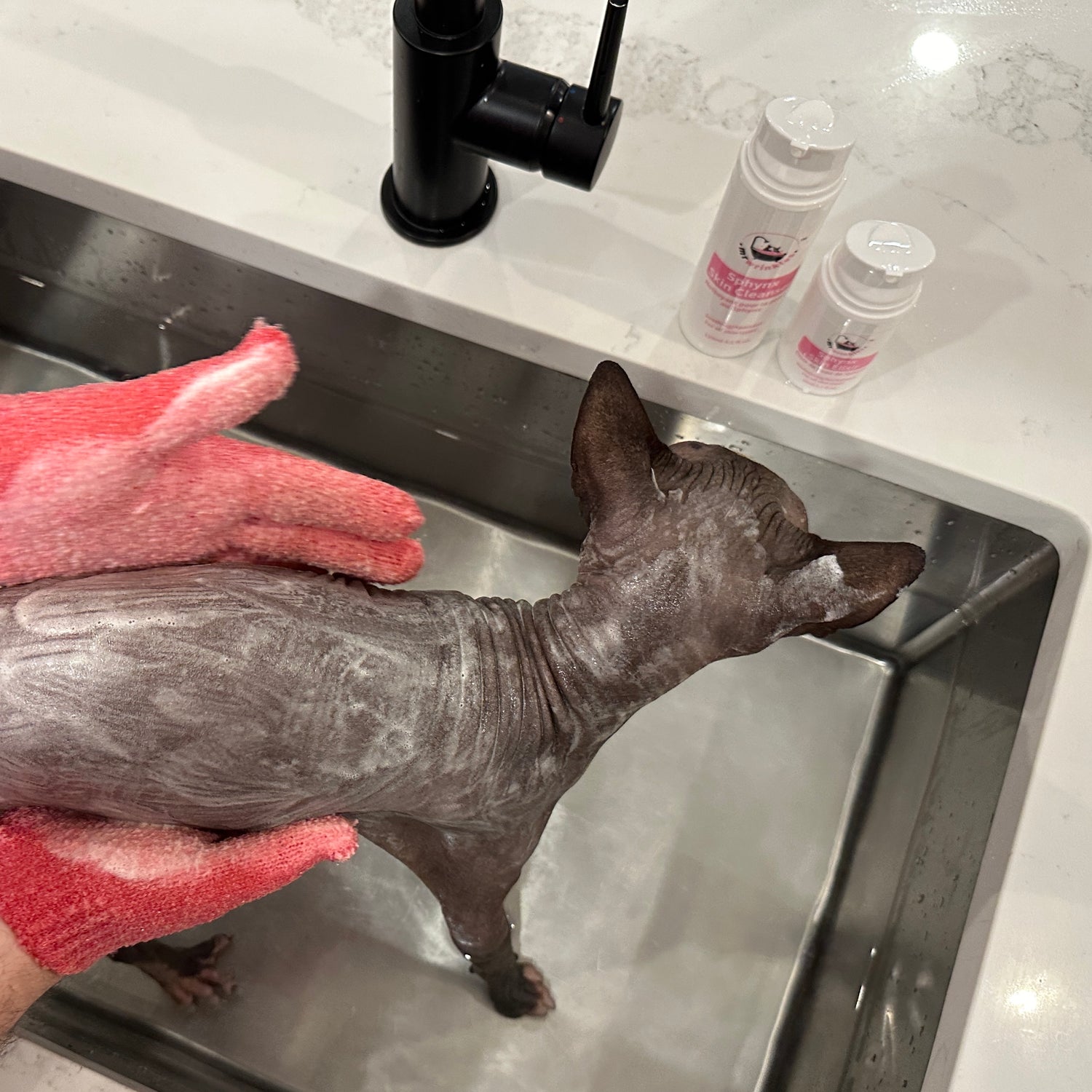


What's the Best Shampoo for Sphynx Cats? (The Answer Might Surprise You)
Share
If you've been searching for the best shampoo for your Sphynx cat, you're asking exactly the right question, just with the wrong word in it.
The honest answer: the best option for your Sphynx isn't a shampoo at all. And once you understand why, you'll never look at the pet care aisle the same way again.
Why Shampoo Is the Wrong Starting Point
Shampoo was invented to clean hair. Specifically, it was engineered to make hair look good — shiny, smooth, and frizz-free. That's not an accident. The hair shaft has a natural acidity that keeps cuticles flat and reflective. Shampoo formulas are pH-adjusted to work with that chemistry, keeping cuticles closed and coats gleaming.
That's exactly what you don't want for a cat with no hair.
Sphynx cats produce the same natural skin oils as any other cat, but without fur to absorb and distribute those oils, they sit directly on the skin. The goal isn't to optimize a coat that doesn't exist. The goal is to gently balance skin that's completely exposed.
A shampoo doing its job perfectly on a coated cat will do exactly the wrong thing on a Sphynx. You'd be using a hair product on a skin problem.
What Makes Sphynx Skin Different
Sphynx skin is exposed skin. No fur means no natural buffer against environmental irritants, temperature changes, or the wrong ingredients. It also means three things that most pet products completely ignore:
pH sensitivity is everything.
Healthy cat skin sits around pH 6.0. Most shampoos, whether formulated for humans, dogs, or coated cats, are pH-adjusted for coat performance, not skin health. For a Sphynx, that distinction matters enormously. Without fur acting as a buffer, the wrong pH directly disrupts the skin barrier and the natural skin microbiome, the community of beneficial bacteria and microorganisms that live on the skin and help protect it from irritation, infection, and imbalance. A cleanser that respects pH 6.0 isn't just being precise. It's actively supporting the invisible ecosystem that keeps your cat's skin healthy.
Oil balance matters more than oil removal.
The waxy buildup Sphynx owners know well isn't dirt. It's sebum, a natural protective oil. The right cleanser manages sebum without stripping it entirely, leaving skin balanced rather than dry and reactive. Aggressive oil removal doesn't solve the problem. It triggers the skin to produce more oil to compensate, creating a cycle that's harder to manage over time.
Ingredients absorb directly and stay on.
With no fur barrier, whatever you put on a Sphynx's skin is in direct contact with it. And unlike a rinse-off product on a furred cat, residue matters more here. A cat who grooms themselves immediately after bathing will ingest whatever remains. Ingredient safety and transparency aren't optional.
The Products That Get It Wrong
Shampoos made for coated cats
These are formulated for a completely different situation. They're pH-adjusted for coat performance, designed to penetrate and clean fur, not to care for bare skin directly. Using them on a Sphynx is a bit like washing your face with hair shampoo. Technically possible. Practically wrong.
Generic pet wipes and waterless sprays
Many contain alcohol, synthetic fragrance, or preservatives that are fine for occasional use on furred pets but problematic for regular use on sensitive exposed skin. Always check the ingredient list carefully.
Products with "Fragrance" or "Parfum" on the label
This one deserves its own explanation. Under cosmetic labeling regulations in the US and Canada, a manufacturer is legally permitted to list any number of undisclosed ingredients under the single term "Fragrance" or "Parfum." It is a trade secret protection built into the law, and it means you genuinely cannot know what's behind that word on the label. For a Sphynx with sensitive exposed skin who grooms immediately after bathing, "Fragrance" on an ingredient list is a reason to put the product back on the shelf.
Unverified products with no ingredient transparency
The pet care market, particularly online marketplaces, is full of products with no clear formulation standards, no safety testing, and no pH specification. For a Sphynx, ingredient transparency isn't a nice-to-have. It's essential.
Dish detergent
We have to address this one directly because it comes up in Sphynx forums more than it should. Yes, we know they can look a little like plucked chickens, but save the dish detergent for the roasting pan. Dish detergent is formulated to cut through grease on dishes, not to respect a living creature's skin barrier. It will strip every natural oil from your cat's skin, disrupt their pH balance, and leave them dry, irritated, and more prone to buildup in the long run. It has exactly one appropriate use case for cats: after a crude oil spill. For everything else, it is the wrong tool entirely.
What to Look For Instead
When evaluating any product for your Sphynx, here's what actually matters:
pH balanced to approximately 6.0 — matched to feline skin chemistry and designed to support the natural skin microbiome, not just clean the surface.
Gentle, non-stripping cleansers — look for naturally derived surfactants rather than harsh foaming agents. Low-suds is a feature, not a flaw. If it doesn't lather dramatically, that's by design.
Full ingredient transparency — no "Fragrance" or "Parfum" hiding undisclosed ingredients. Every component should be listed and identifiable.
Lick-safe ingredients — Sphynx cats groom immediately after bathing. Every ingredient needs to be safe for ingestion.
Formulated specifically for hairless cats — not adapted from human skincare, not repurposed from furred cat products. Purpose-built.
What We Built and Why
When Geoff and Mei-Mei adopted Mr. Wrinkles in December 2022, they went looking for products that met all of those criteria. They couldn't find them. So they spent over a year working with skincare specialists in Vancouver to develop formulas from the ground up, pH balanced at 6.0, naturally sourced, fully transparent on every ingredient, lick-safe, and designed specifically for the unique skin of hairless cats.
The result is a skincare line, not a shampoo line. Because that's what Sphynx cats actually need.
Three cats, Mr. Wrinkles (oily), Luci (dry and flaky), and Nimbus (sensitive), have been living proof that one routine can work across every skin type. Not because it strips everything and starts over. Because it balances, supports, and protects.
Frequently Asked Questions
Can I use regular cat shampoo on my Sphynx?
Many owners do, and some report acceptable results, particularly with gentle, low-surfactant formulas. The concern is that most cat shampoos are pH-adjusted for coat performance rather than direct skin health, and they don't account for the direct contact and absorption that happens without fur as a buffer. A cleanser formulated specifically for hairless cat skin will generally give you better long-term results with less risk of irritation or microbiome disruption.
Can I use human shampoo or baby shampoo on my Sphynx?
Some owners have without immediate incident, but it isn't recommended for regular use. Human shampoos are formulated for human skin pH, which differs from cat skin pH. Regular use can gradually disrupt your cat's skin barrier and natural microbiome, leading to dryness, irritation, or increased oil production over time. For occasional emergencies it's unlikely to cause lasting harm, but for regular bathing a purpose-built product is a meaningfully better choice.
Can I use dish detergent to clean my Sphynx?
Only if they've rolled in crude oil. Dish detergent is designed to cut through grease on dishes. It will strip every natural oil from your cat's skin, disrupt their pH balance, and cause irritation. It is not a safe or appropriate regular cleaning option for any cat, and especially not for a Sphynx with sensitive, exposed skin.
How often should I bathe my Sphynx?
Less than most owners expect. A Sphynx with healthy, well-balanced skin can often go two to three weeks between baths, sometimes longer. Over-bathing is a common mistake that disrupts the skin barrier and triggers increased oil production, making the problem worse over time. If you're working to restore skin that's been stripped or irritated, more frequent gentle cleansing can help in the short term, but the goal is always to build toward a longer, more comfortable interval. With the right products used consistently, most owners find they need to bathe less often over time, not more.
What's the difference between a cat shampoo and a cat skincare cleanser?
A shampoo is designed to clean hair. It typically contains surfactants that strip oils from a coat and rinse away debris, with pH adjusted for coat appearance. A skincare cleanser is designed to clean and balance skin directly. It uses gentler cleansing agents, respects the skin's natural pH, supports the skin microbiome, and protects the skin barrier rather than stripping it. For a Sphynx, a skincare cleanser is the appropriate choice.
Do Sphynx cats need moisturizer after bathing?
Yes, and this is one of the most important and most overlooked parts of Sphynx care. Cleansing temporarily disrupts the skin barrier and removes some of the natural oils that protect it. A nourishing, lick-safe moisturizer applied after bathing helps restore hydration and supports the skin's natural microbiome. Because it's a leave-on product in direct contact with exposed skin, the quality and safety of the ingredients matters even more than in the cleanser. Look for something that absorbs well, contains no hidden fragrance ingredients, and is pH appropriate for feline skin.
Is a Rinse-Free Cleansing Foam a good alternative to bathing for Sphynx cats?
A Rinse-Free Cleansing Foam is an excellent between-bath option that does more than most owners realize. Because it's a leave-on product, it continues to support skin balance after application, helping manage oil buildup, extend the time between full baths, and reduce the stress of frequent bathing for cats who find it difficult. It's particularly useful for spot cleaning problem areas between baths. It isn't a full replacement for regular cleansing, but used consistently it can meaningfully improve skin condition over time.
What should I do if my Sphynx has very oily skin?
Resist the instinct to bathe more frequently. It often makes oily skin worse by triggering the skin to produce more oil in response to stripping. Instead, focus on between-bath management: spot clean problem areas like skin folds and neck wrinkles with a gentle Rinse-Free Cleansing Foam, and wash your cat's bedding and any clothing they wear more regularly to reduce the buildup they're exposed to. A gentle, pH-balanced cleanser used consistently at a reasonable bathing interval will do more for oily skin over time than frequent bathing with the wrong products.
Because hairless skin is different. And the products you choose should know that.